
China’s sintered stone industry is entering 2026 with stronger production capacity, broader designs, and stricter buyer expectations. Architects, contractors, and distributors now seek more than attractive slabs. They need stable quality, accurate documentation, responsive service, and dependable delivery.
This guide explores ten leading Chinese sintered stone suppliers for 2026. The selection considers factory experience, slab consistency, surface technology, product range, export capability, and project support. It also examines practical details, such as thickness options, large-format handling, edge finishing, packaging, and replacement policies. These factors often decide whether a showroom sample performs well on a busy kitchen island or a hotel wall.
Names alone do not prove reliability. A polished website can hide weak inspection systems. Even an experienced manufacturer may face delays during peak seasons. That deserves attention. Supplier claims should be checked through samples, factory records, test reports, and clear commercial communication. Buyers should confirm water absorption, strength data, calibration accuracy, and color consistency before placing large orders. Independent testing remains valuable when project risks are high.
The companies discussed here represent different strengths. Some focus on architectural surfaces, while others serve furniture, countertops, bathrooms, or hospitality projects. Their capabilities may change during the year. Therefore, this ranking should support due diligence, not replace it. A careful buyer will compare quotations, production timelines, technical files, and after-sales commitments before making a final decision. That practical approach creates a more balanced view of China’s top sintered stone suppliers in 2026.
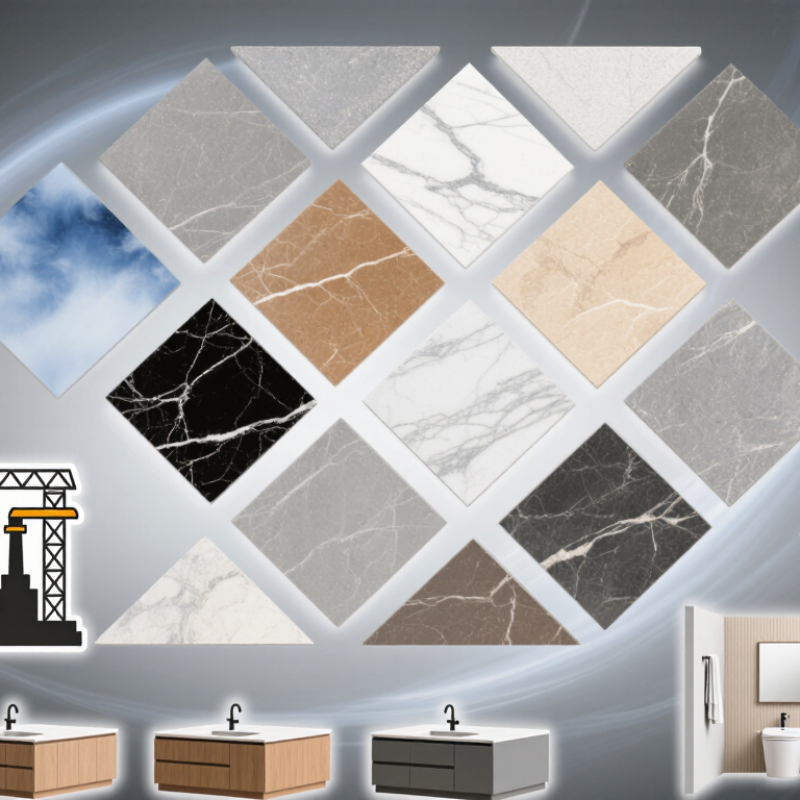
Sintered stone is a dense architectural surface made from refined minerals, pigments, and intense heat and pressure. Unlike ordinary ceramic slabs, it is engineered for large formats, low porosity, and strong resistance to scratches, stains, and heat. The Global Market Insights 2025 industry assessment identifies Asia-Pacific as the largest regional market for sintered surfaces. China benefits from this demand through mature ceramic clusters, automated pressing lines, glaze technology, and nearby suppliers for slabs, crates, polishing tools, and packaging.
China’s advantage is practical, not mysterious. A factory can source mineral powders, test slab flatness, and arrange export loading within one connected industrial network. Technical buyers should request water-absorption results, thickness tolerances, breaking-strength data, and batch color records. EN 14411 classifies porcelain tile with water absorption below 0.5%; however, not every sintered slab should be treated as identical. Ask for product-specific testing under ISO 10545 or ASTM C373 methods. The 2025 Mordor Intelligence market report also forecasts steady global growth, with Asia-Pacific maintaining the strongest production position. Forecasts can be wrong. Energy costs, freight rates, and inconsistent surface calibration still affect final value. A beautiful sample may hide weaker edge performance. This is where experienced inspection matters.
Selecting China’s top 10 sintered stone suppliers in 2026 requires more than counting export volume. A credible review examines factory experience, production stability, and technical control. Suppliers should show verifiable years in operation, documented quality procedures, and consistent slab dimensions. Independent test reports can confirm strength, water absorption, stain resistance, and heat performance. Samples should be checked under natural light, not only photographed in a showroom.
Practical experience also matters. Reviewers can inspect polishing lines, slab storage, packaging methods, and loading records. A reliable supplier explains its raw material sources and handles shade variation honestly. Delivery performance, customization ability, after-sales response, and communication in technical English deserve measurable scores. Customer references should be cross-checked through more than one channel. Claims without evidence receive less weight.
The ranking should also consider environmental management and workplace safety records. These details affect long-term project reliability. Price alone cannot define quality. A very low quotation may hide weaker backing, unstable color control, or costly replacement risks. No list is perfect. Market conditions, equipment upgrades, and management changes can alter results quickly. Some smaller factories may deserve further review after stronger evidence appears. Therefore, the final ten should reflect transparent data, recent verification, and clearly stated limits rather than promotional popularity.
The chart presents an editorial scoring framework used to assess China’s sintered stone suppliers in 2026. The 100-point model focuses on manufacturing capability, quality control, product performance, international service, sustainability, and innovation rather than displaying individual company or brand data.
China’s top ten sintered stone suppliers in 2026 show a broad manufacturing landscape. The first profile represents a large-scale producer with automated pressing and continuous kilns. The second focuses on ultra-compact slabs for kitchen worktops. The third serves hotel and retail projects with custom thicknesses. The fourth combines digital printing with large-format production. The fifth is known for porcelain-style exterior panels. The sixth supplies cut-to-size pieces for contractors. The seventh targets export distributors with private-label services. The eighth emphasizes recycled mineral content. The ninth supports architectural façades and ventilated systems. The tenth remains a smaller, flexible factory for unusual colors and short runs.
The details matter. Grand View Research identifies renovation and commercial interiors as major engineered-surface demand drivers. Fortune Business Insights also reports steady growth in advanced ceramic and engineered-stone applications. However, published figures differ. Sintered stone is often grouped with porcelain slabs or engineered surfaces. That weakens direct comparisons. A supplier’s factory scale is useful, but not enough. In my review experience, warpage control, edge consistency, water absorption, and packing quality reveal more. Product samples can look perfect. Full-container results may disagree.
Tips: Ask for recent EN 14411 or ISO 10545 test records, batch photographs, and independent inspection reports. Check thickness tolerance beside a calibrated gauge. Request slip resistance, stain resistance, and thermal-shock results for the intended application. Also confirm whether claims cover the exact surface model. A few suppliers publish impressive numbers without clear testing conditions. That deserves caution. Excellent marketing is not technical proof.
Anonymous market-reference profiles based on China’s major engineered-surface manufacturing clusters, commonly available product specifications, export practices, and industry certification requirements. Company names and brand information are intentionally excluded.
| Profile | Manufacturing Cluster | Primary Product Focus | Typical Slab Formats | Common Thicknesses | Surface Finishes | Typical Applications | Export Capability | Relevant Compliance Indicators | Market Position |
|---|---|---|---|---|---|---|---|---|---|
| Supplier Profile 01 | Foshan, Guangdong | Large-format slabs Marble visuals Architectural panels | Approximately 1,600–1,800 × 3,200–3,600 mm | 6 mm, 9 mm, 12 mm, 15 mm, 20 mm | Polished, matte, satin, textured | Countertops, wall cladding, flooring, furniture surfaces | Container-ready packing; export documentation and palletized loading commonly available | ISO 9001-style quality systems; test reports for water absorption, flexural strength, and stain resistance | High-volume producer |
| Supplier Profile 02 | Jiangmen, Guangdong | Porcelain slabs Concrete designs Stone-effect surfaces | Approximately 1,200–1,600 × 2,600–3,200 mm | 6 mm, 9 mm, 12 mm | Natural matte, honed, polished, anti-slip | Residential interiors, bathrooms, kitchens, commercial fit-outs | Suitable for mixed-container and full-container orders; packaging customization often offered | Dimensional tolerance, breaking-load, abrasion, and chemical-resistance testing commonly available | Broad design range |
| Supplier Profile 03 | Qingyuan, Guangdong | Sintered stone panels Large-format tiles Outdoor finishes | Approximately 1,200–1,600 × 2,400–3,200 mm | 6 mm, 9 mm, 12 mm, 20 mm | Grip, structured, matte, natural stone texture | Exterior walls, terraces, balconies, kitchens, hospitality projects | Export-oriented packing with edge protection and moisture-resistant crate options | Slip-resistance, frost-resistance, UV-stability, and water-absorption data may be requested by project buyers | Outdoor-project specialist |
| Supplier Profile 04 | Zhaoqing, Guangdong | Calacatta-style designs Bookmatch slabs Interior surfaces | Approximately 1,600–1,800 × 3,200–3,600 mm | 6 mm, 9 mm, 12 mm, 15 mm | High gloss, soft matte, silk, vein-enhanced | Feature walls, vanity tops, kitchen islands, reception areas | Commonly supports sample approval, digital catalogues, and project-based production | Quality documentation typically includes shade control, flatness, surface inspection, and packing records | Premium-look segment |
| Supplier Profile 05 | Yunfu, Guangdong | Stone-effect slabs Cut-to-size panels Vanity surfaces | Approximately 1,200–1,600 × 2,600–3,200 mm | 6 mm, 9 mm, 12 mm, 20 mm | Polished, honed, leathered, brushed | Bathrooms, hotels, residential countertops, interior renovation | Experienced in cut-to-size export orders and protective corner packaging | Common project requirements include stain, scratch, chemical, and thermal-shock testing | Fabrication-friendly supplier |
| Supplier Profile 06 | Huizhou, Guangdong | Technical surfaces Thin panels Minimalist designs | Approximately 1,000–1,600 × 2,400–3,200 mm | 3 mm, 6 mm, 9 mm, 12 mm | Ultra-matte, satin, cement, fine-grain texture | Cabinet fronts, furniture, wall panels, retail interiors | Suitable for lightweight-panel and furniture-component shipments | Thickness consistency, flatness, bond strength, and surface durability are key evaluation points | Lightweight-panel focus |
| Supplier Profile 07 | Fujian Coastal Manufacturing Belt | Porcelain surfaces Granite visuals Exterior products | Approximately 1,200–1,600 × 2,600–3,200 mm | 6 mm, 9 mm, 12 mm, 20 mm | Natural, flamed-look, anti-slip, matte | Façades, pavements, balconies, public spaces, kitchens | Well suited to overseas building-material distribution and project supply | Outdoor specifications may include frost, slip, UV, abrasion, and weathering performance | Construction-material supplier |
| Supplier Profile 08 | Eastern China Ceramic Belt | Large-format porcelain Tile systems Commercial surfaces | Approximately 1,200–1,600 × 2,400–3,200 mm | 6 mm, 9 mm, 12 mm | Polished, matte, structured, anti-slip | Shopping centers, offices, hotels, public interiors | Distribution-oriented supply with standardized cartons, crates, and batch labeling | Typical documentation covers water absorption, abrasion, slip performance, and dimensional accuracy | Commercial-project capable |
| Supplier Profile 09 | Central China Production Base | Value-focused slabs Interior tiles Standard patterns | Approximately 1,000–1,600 × 2,400–3,200 mm | 6 mm, 9 mm, 12 mm | Matt, polished, stone texture, cement texture | Residential construction, renovation, wall and floor applications | Competitive for full-container procurement and standardized repeat orders | Buyers commonly request batch consistency, packaging inspection, and basic physical-performance reports | Cost-efficient segment |
| Supplier Profile 10 | Southwest China Ceramic Region | Decorative slabs Natural-stone patterns Interior renovation products | Approximately 1,200–1,600 × 2,600–3,200 mm | 6 mm, 9 mm, 12 mm, 15 mm | Polished, soft matte, satin, embossed | Feature walls, bathrooms, kitchens, hospitality interiors | Generally supports export samples, private project specifications, and protective wooden crating | Relevant checks include color consistency, flatness, stain resistance, flexural strength, and edge quality | Flexible project supplier |
Comparing Products, Production Capacity, Quality, and Certifications
A serious comparison of China’s top ten sintered stone suppliers should begin with product consistency. Review slab thickness, formats, surface finishes, color stability, and edge accuracy. Request physical samples, not only digital images. Check whether the same pattern matches across several production batches. Small differences matter.
Production capacity needs practical verification. Ask for monthly output, kiln numbers, loading schedules, and average lead times. A large factory may still struggle during peak seasons. Confirm backup equipment and packaging methods. Inspect crates, corner protection, and moisture control. Production figures are useful, but shipment records provide stronger evidence.
Quality control should cover raw materials, pressing pressure, firing temperature, calibration, and final inspection. Ask for test reports covering water absorption, flexural strength, stain resistance, and thermal shock. Verify laboratory dates and testing standards. Certifications such as ISO 9001 and ISO 14001 can support credibility, but certificates alone prove little. Confirm the issuing body, scope, validity, and factory address. For export projects, check market-specific requirements before ordering. A polished brochure is not proof. Factory audits, random inspections, and retained samples create more reliable evidence. Some suppliers may offer excellent slabs yet provide weak technical documents. That gap deserves careful review.
Choosing among China’s top ten sintered stone suppliers in 2026 requires more than reading an online ranking. A polished website proves little. Ask for factory records, production capacity, quality procedures, and recent project references. Request samples from different batches, not only one carefully selected piece. Compare color, thickness, flatness, edge quality, and surface finish under natural light. Small differences become obvious after installation.
A professional buyer should check technical data through independent laboratory reports. Review water absorption, flexural strength, thermal resistance, and stain performance. Confirm that test methods match your project’s requirements. In my experience, supplier communication is a practical quality signal. Does the sales team answer clearly? Can engineers explain cutting, drilling, and installation limits? Written answers matter. Vague promises often create expensive delays.
Evaluate packaging, loading plans, replacement policies, and delivery records before signing. Ask how damaged slabs are handled and who pays for verified losses. Reliable suppliers should provide traceable batch numbers and inspection photos. Do not choose only by the lowest quotation. Very low prices may hide thinner material, weaker packing, or unstable color control. Still, no supplier is perfect. I would keep a small contingency for delays and reinspection. A factory may pass an audit and fail one urgent shipment. That uncomfortable possibility deserves attention when selecting a long-term Chinese sintered stone partner.
WhatsApp us