What Is a Dual Frequency Card and How Does It Work?
A Dual Frequency Card can communicate through two radio-frequency interfaces, often combining low-frequency (LF) and high-frequency (HF) technology. The exact pairing varies by product. Each interface needs a compatible reader; two frequencies do not mean every reader can access both. Small card. Two radio paths.
RFID Journal founder Mark Roberti is an established industry voice. An editorial paraphrase of a practical RFID principle associated with his field is: “A card works best when its frequencies match the reader and the task.” This is a paraphrase, not a verified verbatim quotation. In practice, one card might serve separate systems, such as a building reader at a doorway and another reader at a service desk. The card’s antennas and chips must be designed for their intended frequencies, and the systems must be configured to recognize them. A card may look ordinary, yet its performance depends on details users rarely see.
The label can sound simpler than the engineering is. Frequency support alone does not guarantee compatibility, security, or reliable reading. Materials, reader settings, distance, and installation can all affect results. A careful buyer should check the card’s frequency specifications and confirm them with the system provider. There is no universal dual-frequency design. That is easy to overlook. Done well, the card can reduce the need to carry separate credentials, but its value depends on the real environment, not just the product name.
Definition and Purpose of a Dual Frequency Card
A dual frequency card is a credential designed to communicate on two radio-frequency bands. Many access cards combine a low-frequency interface, often around 125 kHz, with a high-frequency interface, commonly 13.56 MHz. The exact frequencies and technologies depend on the card and reader system. Two signals. One card. Its purpose is practical: a single card can support compatible readers in different areas, such as an older office entrance and a newer staff room. It does not mean every reader will recognize the card.
Inside the card, separate antenna structures or electronic components support communication at each frequency. When a person presents it near a reader, the reader’s field powers or detects the relevant interface and exchanges credential data. Usually, the card must be enrolled in the system first. A card that works at one door may fail at another if the reader uses a different protocol or expects a different credential. That distinction matters. Dual frequency describes radio compatibility, not automatic access or stronger security. Administrators should check supported frequencies, protocols, and enrollment requirements before issuing cards. Even then, documentation can be incomplete, so testing a sample card at each reader is sensible. A small detail, but an easy one to overlook.
What Is a Dual Frequency Card and How Does It Work? - Definition and Purpose of a Dual Frequency Card | Dimension | Details |
| Definition | A dual frequency card contains technology that can communicate at two different radio frequencies. In access-control applications, a common combination is low frequency (LF) and high frequency (HF). |
| Common frequency pair | 125 kHz LF and 13.56 MHz HF are frequently used together. Actual frequencies and supported technologies depend on the card design. |
| How it works | A compatible reader generates a radio-frequency field. The card responds through the corresponding antenna and chip circuitry for that frequency. A dual frequency card may use separate components for each frequency. |
| LF characteristics | 125 kHz systems are commonly used for identification and access control. Their capabilities vary by card and system, and many basic implementations provide limited security features. |
| HF characteristics | 13.56 MHz systems include technologies based on standards such as ISO/IEC 14443 and ISO/IEC 15693. Supported features and communication ranges vary by implementation. |
| Purpose | Combining two frequencies can help one card work with compatible readers from different systems, such as when an organization is migrating to a newer card technology. |
| Reader compatibility | A dual frequency card does not work with every reader. The reader must support the card’s frequency, communication protocol, and relevant credentials. |
| Credential behavior | The two technologies may present different identifiers or credentials. System administrators should confirm how each reader recognizes and authorizes the card. |
| Security considerations | Security depends on the chip, protocol, credential configuration, and access-control system—not simply on the number of frequencies. Older or basic card technologies may be vulnerable to copying or unauthorized reading. |
| Practical check before use | Confirm both operating frequencies, supported standards, reader compatibility, credential format, and security requirements with the system documentation or administrator. |
| Important limitation | “Dual frequency card” is a general description, not a single universal standard. Product capabilities differ, so specifications should be checked for the particular card and reader system. |
Frequency Bands and Their Roles
A dual-frequency card is built to communicate on two radio bands, often low frequency (LF, around 125 kHz) and high frequency (HF, 13.56 MHz). LF is commonly used for close-range identification, where a card is held near a reader. HF supports contactless credentials and NFC-style exchanges. The NFC Forum specifies 13.56 MHz for NFC, while ISO/IEC 14443 defines proximity cards operating at that frequency. These standards help clarify what a card can do; the words “dual frequency” alone do not.
Some cards combine HF with ultra-high frequency (UHF). GS1’s EPC UHF Gen2 specification covers 860–960 MHz, a range used for longer-distance and bulk reading, such as inventory checks. LF and HF generally suit deliberate close presentation; UHF can be read from farther away. Actual performance depends on the antenna, reader, nearby materials, and setup. There is no single universal dual-frequency pairing, and a published range may not match a real doorway or desk.
Tips: Check the card’s exact frequencies and standards, then test it with the intended reader. A card that works at a clean lab bench may behave differently beside metal, a phone, or several nearby cards.
Key Components Inside the Card
A dual-frequency card usually combines a low-frequency coil with a high-frequency antenna. Common pairings use 125 or 134.2 kHz alongside 13.56 MHz, though designs vary. ISO/IEC 11784 and 11785 specify low-frequency identification systems, while ISO/IEC 14443 covers 13.56 MHz proximity cards. These standards document the operating frequencies, not one universal card layout. The distinction matters: two cards with the same frequency labels may contain different chips and behave differently at a reader.
Inside, copper wire or etched metal forms each antenna. A tuning capacitor helps each coil respond to its intended frequency. The chip stores identification data and controls communication; its rectifier converts energy from the reader into power for the circuit. Small details matter. A poorly tuned coil can reduce read distance. Some cards use two chips, while others use one chip designed for both bands. The NFC Forum’s technical specifications also describe 13.56 MHz NFC operation and data exchange. In practice, card makers must balance antenna size, chip placement, and the plastic layers surrounding them. That balance is rarely perfect. Testing with the actual reader is more useful than relying on a label alone.
How the Card Communicates With a Reader
A dual-frequency card can communicate through two radio bands, commonly 125 kHz and 13.56 MHz. Some designs use separate chips and antennas; others integrate the components differently. When a reader creates a field at the card’s supported frequency, the card’s antenna receives energy and sends back its credential using a defined protocol. The reader must support the same frequency and protocol. A dual-frequency card does not make every reader compatible.
NFC Forum’s technical overview identifies 13.56 MHz as NFC’s operating frequency and gives a typical maximum range of about 2 cm. ISO/IEC 14443-2:2020 specifies radio-frequency power and signal interfaces for proximity cards. These references help explain why placement matters: hold the card near the reader’s marked area, often a few centimeters from its face. The reader energizes the card, exchanges signals, then checks the returned data. Still, real-world reads can be less tidy than diagrams suggest; metal, card orientation, or competing signals may affect performance.
Tips: Ask which frequencies and protocols a reader supports before testing a card. Try each side near the reader’s center, and pause briefly. If one reader works and another does not, the mismatch may be in frequency or protocol—not necessarily a damaged card.
What Is a Dual Frequency Card and How Does It Work?
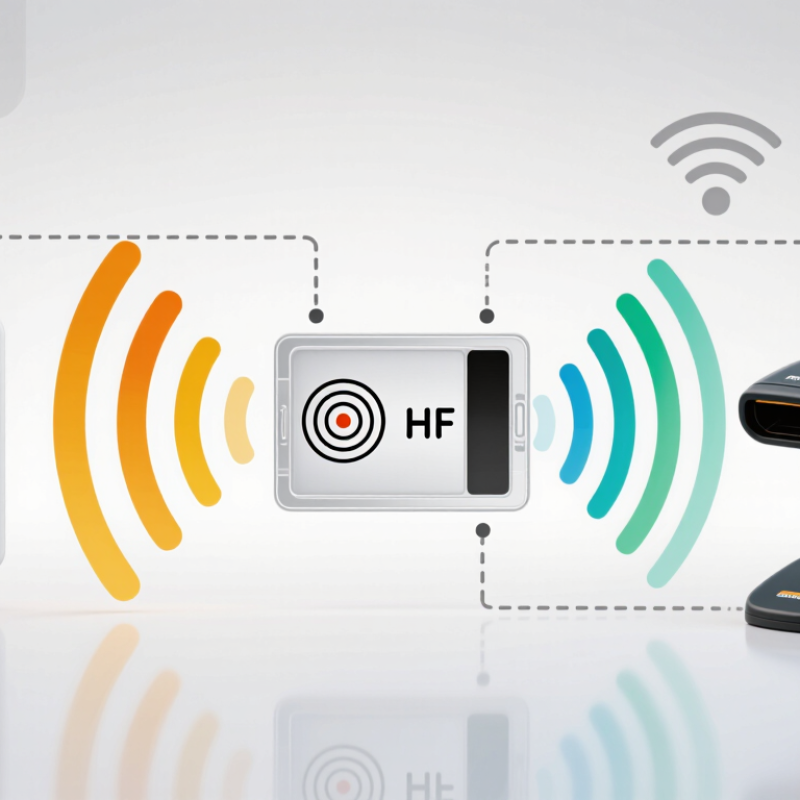
Typical LF and HF RFID carrier frequencies used by dual-frequency cards
A dual-frequency card supports two radio-frequency bands, commonly LF at 125 kHz and HF at 13.56 MHz. A compatible reader generates a field at the matching frequency; the card uses that field to communicate its data. Actual protocols and read ranges vary by card and reader.
Common Uses and Compatibility Considerations
A dual-frequency card is useful when a site has readers operating at different radio frequencies, often 125 kHz and 13.56 MHz. One card may support both, allowing a person to use older door readers while newer equipment is introduced. Offices, campuses, and shared residential buildings may use this arrangement during a gradual access-system upgrade. Less to carry.
Compatibility takes more than matching frequencies. The card and reader must also support compatible communication standards, credential formats, and system settings. A 13.56 MHz reader, for example, will not necessarily recognize every card using that frequency. Check the reader specifications and have the system administrator confirm the card’s credential is enrolled correctly. Testing one card at each type of reader can catch problems before a wider rollout.
Some cards present different credentials on different frequency interfaces. That can help separate older and newer systems, but it may also complicate replacements or troubleshooting. Keep a record of which readers use which credentials. And don’t assume the card works everywhere. I’ve seen “dual frequency” treated like a universal pass; the label alone does not prove compatibility. Reader firmware, configuration, and card design matter.