How to Choose the Best Anti Block Masterbatch for Your Needs?
Choosing the right anti block masterbatch is crucial in various industries, particularly in plastics manufacturing. According to a report by MarketsandMarkets, the global market for anti block additives is expected to reach $1.2 billion by 2025. This growth underscores the importance of selecting high-quality masterbatches to enhance product performance and efficiency.
Anti block masterbatch serves a vital role in preventing adhesion between plastic films and sheets. However, not all masterbatches are created equal. Factors such as particle size, compatibility, and processing temperatures can significantly impact their effectiveness. A study from the Plastics Industry Association highlights that poorly chosen additives may lead to film defects and increased production costs.
Moreover, environmental considerations are becoming increasingly important. Many manufacturers now seek eco-friendly options in their anti block masterbatch selection. This challenge prompts a need for deeper understanding and research. Navigating through the choices requires both experience and technical knowledge. Balancing performance with sustainability is essential, reflecting the ongoing evolution in this field.
Understanding Anti Block Masterbatch: Definition and Purpose
Anti block masterbatch is essential in the plastic industry. It minimizes sticking between polymer films. This property enhances the usability of films during processing and packaging.
Understanding how anti block masterbatch works can help in choosing the right one. These additives contain specific particles that create space between layers. This prevents surface contact which leads to unwanted sticking. However, not all masterbatches perform equally in different applications. The choice largely depends on the type of materials used and the intended purpose.
While it can be tempting to go for the most popular option, looking deeper is necessary. For instance, the ratio of anti-block agents may not suit your specific needs. Testing different formulations could lead to better results. Be cautious of trade-offs, too. Some products reduce clarity while enhancing slip. Balancing these factors is crucial in achieving optimal performance in your applications.
Types of Anti Block Masterbatch Available in the Market
When selecting an anti block masterbatch, understanding the types available is crucial. Anti block masterbatches are essential in plastic processing, helping to reduce the blocking of films. The most common types include mineral-based and additive-based masterbatches. Mineral-based options contain materials like talc or calcium carbonate. These create a particulate barrier, enhancing slip properties. Additive-based masterbatches often use organic compounds that provide better dispersion in plastics.
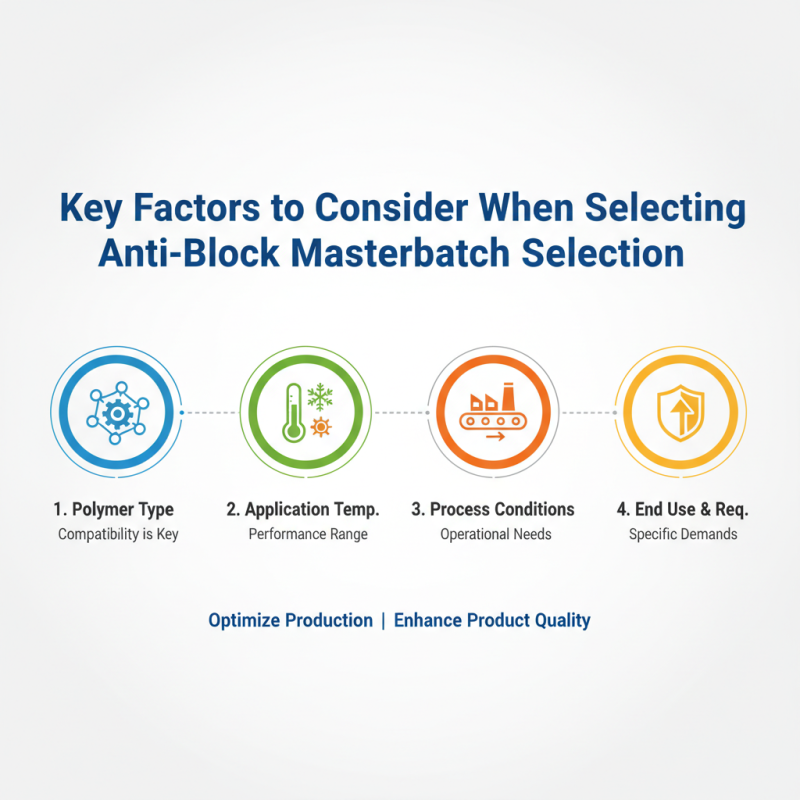
Tips: Always consider the compatibility with your base resin. Testing small batches can save future complications. Verify the processing temperature and ensure the masterbatch functions effectively under your specific conditions.
Another type to consider is biodegradable anti block masterbatch. As environmental concerns rise, these options use natural materials to achieve similar effects without harming the planet. They maintain performance while contributing positively to sustainability. However, evaluating their true effectiveness compared to traditional products can be challenging.
Remember, not all masterbatches perform the same across various applications. Some may work well in specific temperatures but fail under others. Conducting thorough testing is essential to find the right match for your needs.
Evaluating Performance and Compatibility with Your Materials
Choosing the right anti-block masterbatch is essential for enhancing the performance of your materials. Factors like compatibility with base polymers play a crucial role. For instance, some masterbatches are designed specifically for polyethylene, while others work best with polypropylene. Testing the synergy between your selected masterbatch and raw materials can provide insight into performance.
Materials often interact in unpredictable ways. What works well in one application may not suit another. Evaluate the anti-block effectiveness through practical trials. Look for the desired level of anti-blocking while monitoring other essential properties, such as clarity and processing stability. Each material has unique characteristics that can influence the final product quality.
Conducting compatibility tests is a proactive approach. Understand how your materials behave with different masterbatches. Sometimes, adjustments are necessary to achieve optimal results. Remember, not every solution will fit all scenarios. This requires an iterative process of testing and adjusting until you find the right balance. Your goal is to ensure the materials work harmoniously together, improving overall performance.
How to Choose the Best Anti Block Masterbatch for Your Needs?
| Characteristic |
Description |
Compatibility |
Performance |
| Type of Anti Block Agent |
Natural or synthetic agents used to prevent sticking. |
Polyethylene, Polypropylene |
Effective at preventing film stickiness. |
| Addition Rate |
The percentage of masterbatch to be added to polymers. |
Must match polymer type for best results. |
Higher rates can enhance performance but may affect clarity. |
| Processing Temperature |
The temperature at which the masterbatch performs effectively. |
Needs to align with the processing conditions of the polymer. |
Maintains performance within a specific temperature range. |
| Color Impact |
Effect of masterbatch on the color of the final product. |
Consider color compatibility with desired outcome. |
May lead to milky or hazy finish in some cases. |
| Cost Efficiency |
Relative expense of the masterbatch in production. |
Balance between cost and performance needed. |
Should provide value through enhanced product performance. |
Cost Considerations and Supplier Reliability in Your Choice
When selecting an anti block masterbatch, cost considerations are vital. The price can vary widely among different suppliers. It’s essential to assess the value offered relative to the cost. Sometimes, a cheaper option may not deliver the desired quality. This could lead to higher long-term costs. Failing to consider these factors upfront might ruin production efficiency later.
Supplier reliability is another critical aspect. Not all companies provide consistent quality. Researching a supplier's reputation through reviews or industry recommendations can be beneficial. Good communication is essential too. If a supplier is unresponsive, they might not prioritize your needs. A reliable partner ensures timely delivery and support, which can affect overall production timelines. Consider past performance and client feedback to gauge reliability.
Balancing cost and quality is complex. It often requires a reflective decision-making process. Sometimes, it may feel tempting to choose the lowest price. However, that choice might require re-evaluation down the line. Prioritizing long-term relationships with reliable suppliers may yield greater benefits. Efficient production processes often hinge on these fundamental choices.