
Best Polymer Tape Casting Machine Manufacturer in China
Choosing the Best Polymer Tape Casting Machine Manufacturer in China starts with the material, not a sales brochure. Polymer formulations behave differently during mixing, coating, drying, and winding. A suitable Polymer Tape Casting Machine should match the intended resin, solvent or water-based system, target thickness, and production width. These details shape practical choices, including the coating head, web-tension controls, drying-zone length, and winding method.
Look beyond headline speed. Ask manufacturers how they measure coating thickness, control temperature across the web, and manage tension when a tape is thin or delicate. Request relevant machine drawings, component specifications, and test-run records using a material similar to yours. A clear acceptance plan helps both sides agree on measurable results before shipment. Useful details include line speed under defined conditions, thickness variation, usable width, and the method used to inspect samples. Small details matter.
Supplier evaluation should also cover installation, operator training, spare parts, and response times for technical support. Confirm which services are included and which require additional fees. A polished specification sheet is helpful, but it cannot replace a properly documented trial. Still, specifications can mislead. Test conditions may not match your production floor, and sample results may vary with material preparation or ambient conditions. Ask what assumptions were used, and record the answers. No machine removes every process challenge. The strongest purchasing decision comes from matching verified capabilities to your actual production needs, then reviewing any remaining gaps honestly.
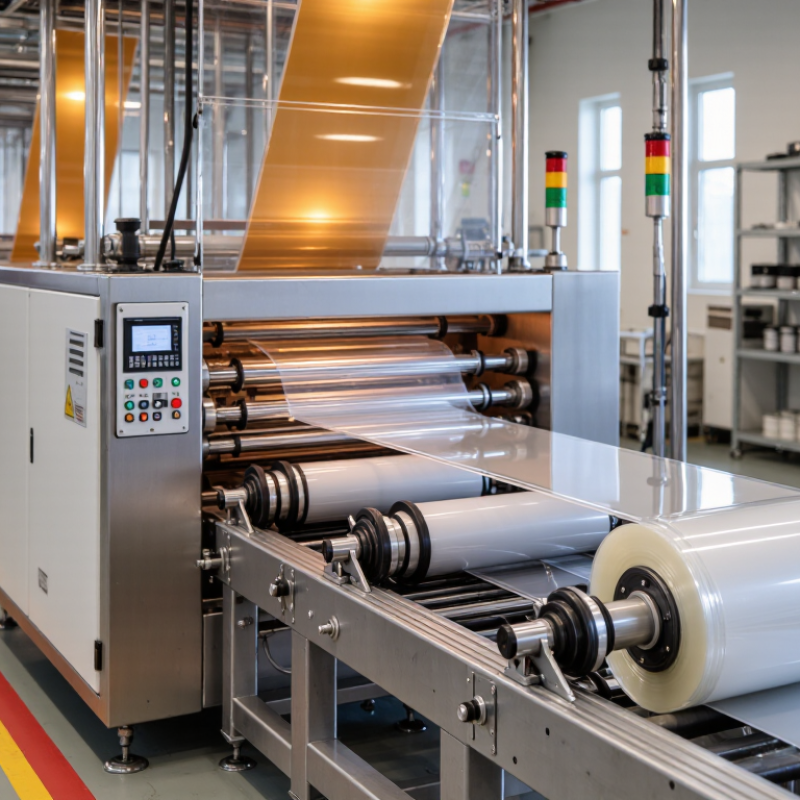
Table of Contents [Hide]
Polymer Tape Casting Machines: Definition and Purpose
A polymer tape casting machine converts a flowable polymer mixture into a thin, continuous sheet. It deposits material onto a moving carrier, often using a doctor blade or precision coating head. The wet layer passes through controlled drying zones before winding or further processing. The goal is control.
Operators adjust the coating gap, web speed, and drying temperature to influence thickness and surface quality. For example, a small change in blade clearance can create visible variation across a tape only a few hundred microns thick. Slurry viscosity and mixing also matter. No machine fixes a poorly prepared batch. Small changes matter.
These machines support the production of polymer films and functional tapes for later converting, testing, or assembly. A stable process can reduce streaks, bubbles, and uneven edges, but results depend on material behavior and operating conditions. A slight edge bead may remain, even when the center looks uniform. That is worth checking, not ignoring. Good process records help teams compare runs and identify whether a defect began during mixing, coating, or drying. The equipment provides repeatable control; it does not replace careful inspection or practical process judgment.
| Dimension | Description | Purpose or Practical Consideration |
|---|---|---|
| Definition | A polymer tape casting machine spreads a liquid or paste-like polymer formulation into a continuous layer on a moving or stationary carrier surface. | It produces a flat, continuous film or sheet whose thickness and surface quality depend on the formulation and process settings. |
| Typical process | The formulation is prepared, fed to a casting area, metered by a blade or coating head, and then dried or otherwise solidified. | Controlled, repeatable stages help create consistent material across a production run. |
| Casting head | A doctor blade or another metering head controls how much formulation is deposited onto the substrate. | Adjustment and alignment affect wet-layer thickness and coating uniformity. The appropriate head depends on the formulation and required product. |
| Substrate or carrier | A moving web or flat carrier supports the wet layer during casting and, where suitable, drying. | Substrate compatibility, surface condition, and release behavior can influence adhesion, defects, and removal of the finished tape. |
| Drying or solidification | Depending on the formulation, the deposited layer may be dried in a controlled zone or solidified by another suitable method. | Conditions should be matched to the material. Solvent-containing formulations also require appropriate ventilation and process-safety measures. |
| Key process controls | Common controls include feed rate, casting gap, web speed, tension, temperature, and drying conditions. | These variables interact; they should be selected and validated for the specific formulation, substrate, and target film properties. |
| Product characteristics | Relevant outcomes may include thickness consistency, width, surface appearance, flexibility, and dimensional stability. | Define measurable product requirements before choosing equipment or setting operating conditions. |
| Typical applications | Depending on the polymer formulation and machine configuration, cast polymer films may be used in areas such as membranes, functional films, or flexible sheet materials. | Application requirements determine the necessary material properties, process controls, and downstream handling. |
| Equipment selection | Compare usable casting width, metering method, substrate handling, drying capability, control system, cleaning access, and safety provisions. | Request trials or process validation using the intended formulation and substrate; confirm that the proposed configuration meets documented product requirements. |
| Quality checks | Inspection may include thickness measurement, visual examination, width checks, and tests relevant to the intended application. | Use a defined sampling plan and calibrated measurement methods to monitor consistency and identify process variation. |