How Does an Automatic Water Spray Retort Steam System Work?
An Automatic Water Spray Retort Steam system uses steam to heat process water, then circulates that water across packaged products inside a sealed vessel. A pump moves the water through spray nozzles, creating a moving curtain over cans, jars, or suitable pouches. The water carries heat to package surfaces and helps distribute it through the load. It is not simply a steam bath. The details matter.
During processing, sensors track conditions such as temperature and pressure, while controls manage heating, holding, and cooling. The retort maintains pressure to help protect packages as temperatures rise and fall. Steam supplies the heat; circulating water transfers it to the product. That distinction is useful when comparing systems or reviewing a process diagram. A steady spray also depends on sound circulation and unobstructed nozzles. Small faults can affect uniformity.
The exact cycle depends on the food, package, load arrangement, and equipment design. A displayed chamber temperature alone cannot prove that every package received the intended treatment. Product-specific process development and validation are essential, with records reviewed by qualified specialists. This part can feel less straightforward than the machine’s controls suggest. Real loads behave differently. Understanding how steam, water flow, pressure, and time work together helps operators ask better questions and interpret process data carefully. No single setting fits every product.
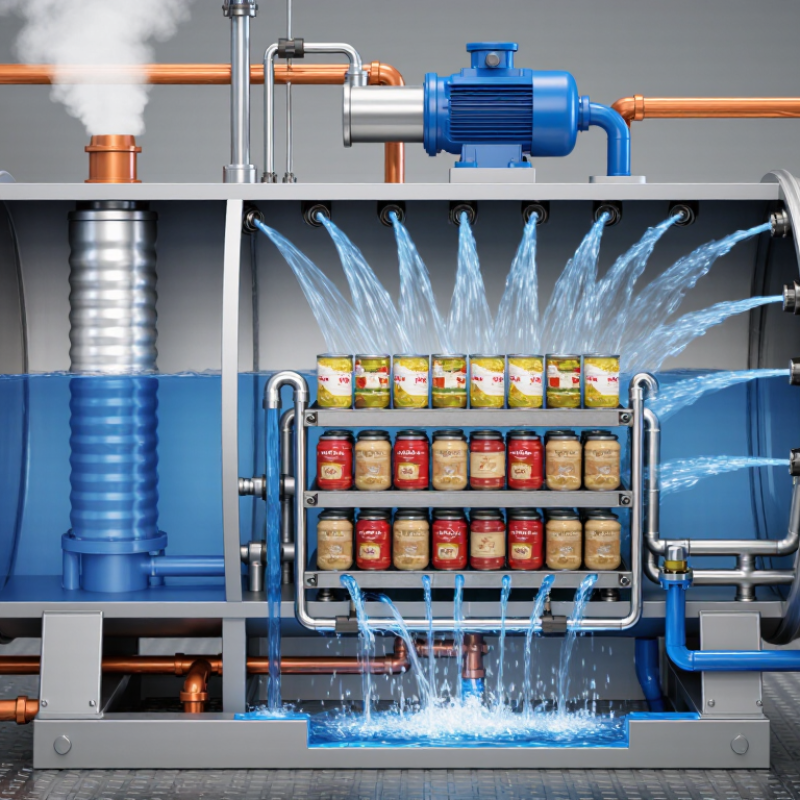
Core Components: Steam Supply, Spray Circuit, Retort Vessel, and Controls
An automatic water spray retort uses steam, circulating water, a pressure-rated vessel, and control equipment to heat packaged products evenly. The steam supply provides the energy. Depending on the design, steam heats the spray water through a heat exchanger or enters the heating circuit directly. Pumps move water to spray headers, where nozzles spread it across baskets and containers. Nozzle condition matters: a partly blocked opening can leave a cooler area.
Inside the retort vessel, packages sit in a defined loading pattern while hot water flows over them. The vessel maintains the temperature and pressure required by the scheduled process. Pressure helps protect flexible containers from excessive expansion, especially during heating and cooling. Small details matter. Dense loading or poorly aimed sprays can affect heat distribution, so equipment performance should be checked with the actual product and pack arrangement.
Controls coordinate steam input, circulation, temperature, pressure, and process time. Sensors provide readings, while the control system follows the approved schedule and records operating data for review. Operators should verify sensor calibration, inspect spray paths, and confirm that the recorded cycle matches the process requirements. Automation reduces routine adjustment, but it cannot correct a weak process design. Even a well-maintained retort may need closer assessment when the product, container, or loading pattern changes.
How Does an Automatic Water Spray Retort Steam System Work?
Illustrative retort temperature profile through heating, holding, and cooling.
How the system works: Steam supplies heat to the circulating water, and the spray circuit distributes that heated water around the product inside the retort vessel. Controls monitor and regulate the process, including temperature, pressure, and time. The plotted 121.1°C hold is illustrative only; actual schedules must be validated for the specific product, container, load, and equipment.
Preheating and Air Removal: Preparing the Load for Uniform Heating
Before a water spray retort begins its scheduled heating phase, the load and circulating system need to approach consistent conditions. The controller may preheat the process water and chamber, reducing the temperature gap between the spray and product containers. Warm water flowing across jars or cans also helps limit uneven temperature rise. Small details matter. Containers should be loaded with enough space for water to reach their surfaces, without blocking spray channels.
Air removal is just as important. Trapped air can interfere with heat transfer and create cooler areas, even when the chamber temperature appears correct. Depending on the retort design, air is displaced through controlled venting, steam purging, or another validated method. The operator should confirm that vents and drains are clear and that the prescribed air-removal sequence completes before the process moves forward.
It is easy to overlook a slow vent. That deserves attention. A temperature reading alone cannot prove that air has been removed uniformly. During setup, check circulation, load arrangement, and recorded sensor readings against the approved process. Preheating prepares the system; careful verification helps show whether the preparation worked as intended.
Steam Heating and Water Spray: Reaching the Validated Process Setpoint
An automatic water spray retort uses steam to heat the vessel while circulating water over packaged food. Steam raises the retort temperature, and spray nozzles distribute heated water across baskets and containers. The water helps limit temperature differences between positions in the load. Small details matter.
Controls monitor temperature and pressure as the system approaches its validated process setpoint. That setpoint is established through process validation, including heat penetration studies that identify how quickly the slowest-heating product reaches the required conditions. It is not simply a number copied from a display. Package size, fill weight, loading pattern, and initial product temperature can all affect heating.
During the holding phase, sensors and recorded data help confirm that the scheduled conditions are maintained. A blocked nozzle or unevenly loaded basket can change circulation, even when the control panel appears normal. Before production, operators should check instruments, spray patterns, and load arrangements against approved procedures. Real cycles are not always perfectly tidy; small temperature variations deserve investigation, not guesswork.
Thermal-Lethality Control: Calculating F₀ at 121.1°C with z = 10°C
In an automatic water spray retort, steam heats recirculating water, which sprays across the load. The spray helps transfer heat to containers, but the retort sensor does not reveal the temperature at a product’s cold spot. That distinction matters when calculating F₀.
F₀ expresses accumulated heat treatment as equivalent minutes at 121.1°C, using z = 10°C. At 121.1°C, one minute adds one F₀ minute. At 111.1°C, the rate is one-tenth as large, so ten minutes add about one F₀ minute.
The calculation integrates these changing rates over the product’s measured temperature history: F₀ = ∫10^((T−121.1)/10) dt. Small differences matter.
A reliable calculation needs calibrated sensors, consistent time-temperature records, and a probe placed to measure the product’s slowest-heating location. Come-up and cooling periods may contribute lethality if the product remains hot; excluding them automatically can distort the result.
Still, the number can mislead. A satisfactory F₀ reading alone cannot confirm that every container experienced the intended process. Review the full temperature profile and validate the scheduled process for the product, package, and retort arrangement. A missed probe placement is easy to overlook.
Cooling and Pressure Release: Protecting Packages Before Batch Unloading
In an automatic water spray retort, cooling begins after the scheduled heat process is complete. Spray nozzles distribute water over the packages, removing heat while the vessel remains controlled. The water may be cooler than the product, but the change should be gradual. A sudden temperature drop can stress containers and seals.
Pressure control matters just as much. As the product cools, internal package pressure changes. The retort may maintain compressed air or regulated vessel pressure to help prevent flexible pouches from ballooning and rigid containers from distorting. Operators should follow validated settings for the specific package and load; one pressure profile does not fit every product. Small details count. A poorly positioned sensor or uneven spray pattern can make cooling less consistent than the display suggests.
Pressure is released in a controlled sequence, not by opening the vessel early. The system should allow pressure to approach the safe unloading condition while cooling reaches its defined endpoint. Staff can then confirm readings and inspect representative packages for leaks, bulging, or damaged seams before batch unloading. It is tempting to treat the cycle as finished once the temperature falls. Not quite yet. Cooling time, pressure stability, and package condition all deserve attention, and the process should be reviewed when results look uneven.